
Why the Curious Peak Late
Careful how you compare yourself

In 1513, Raphael was making a fortune essentially as a more-reliable Leonardo. At thirty, Raphael had already done his best work. Leonardo, in his sixties, was just across the courtyard, still working on the Mona Lisa.
Were it not for Michelangelo’s ceiling down the hallway, Raphael’s giant murals in the pope’s apartment would have been the undisputed greatest accomplishment in Renaissance painting. While completing those, he had also been painting dozens of portraits for the pope and his closest friends.
Raphael was incredibly prolific. Leonardo would only finish maybe a dozen paintings in his lifetime, and his most-famous Mona Lisa was only the size of a serving tray.
Raphael had at this point been steadily employed for years at the Vatican. Leonardo had just arrived, and wouldn’t last long. He would soon leave all the noblemen and clergy in Italy that might have served as his patrons and make an arduous trek 700 miles over the Alps, to find work. He would never return.
Perhaps there is a Raphael you compare yourself to. Someone who cranks out one thing after another, while you struggle to achieve a vague vision of a masterpiece. Someone younger and faster, who you watch achieve rapid success while you toil in obscurity.
On the surface, it may seem they are more talented, disciplined, or focused. If you look closely, you may find you’re merely more curious.
The economist David Galenson wondered, At what point in painters’ careers do they produce their best work? As you might expect from an economist, he started by tracking paintings’ values at auction. He then measured influence by tracking how often each piece was cited in art history books.
Galenson expected to find a neat pattern, such as that more- or less-experienced painters did more valuable and influential work. Instead, he found two distinct trajectories: One group peaked early, the other peaked late.
Two archetypal examples are Picasso and Cézanne. Picasso did his best work at twenty-six, then lived into his nineties, never matching that significance. Cézanne did better work as time went on. He did his most-valuable and influential work the final year of his life, at sixty-seven.
Galenson has noticed a similar pattern in other creative disciplines. Orson Welles directed Citizen Kane at twenty-six, Herman Melville wrote Moby Dick at thirty-two, and Maya Lin designed the Vietnam Veteran’s Memorial while she was still in college. Meanwhile, Alfred Hitchcock released Psycho in his sixties, Fyodor Dostoevsky finished The Brothers Karamazov at fifty-nine, and Frank Lloyd Wright began the Guggenheim Museum at seventy-six.
Leonardo never officially finished the Mona Lisa. It was still in his studio when he died in his late sixties. Raphael finished The School of Athens well before his thirtieth birthday.1
How was Raphael able to be so prolific at such a young age? The answer tells us why curious people like Leonardo peak late.
Leonardo is the quintessential “Renaissance man”: painter, engineer, botanist, architect, and more. He even has an inaccurate reputation as not really being that interested in painting – used as an explanation for why he rarely finished.
Raphael was himself a Renaissance man. Besides his incredible output in painting, he became the chief architect of the Vatican, pioneered the field of archeology, and was an innovative entrepreneur.
But look closely at the differences between these pursuits. Raphael was driven to build upon and organize what other humans had already made. Leonardo was interested in understanding nature through direct observations.
When Galenson looked closer, he noticed that the career trajectories of creatives didn’t depend upon whether they had formal training, what time period they were working in, nor what country they were from. What mattered was how they approached their work.
He found that artists such as Raphael had what he calls a conceptual approach. They would seize on an idea, then execute it. Artists such as Leonardo had an experimental approach. They would tinker and through a long process of trial-and-error eventually, maybe, sometimes arrive at a solution.
In other words, they were more curious.
For example, Cézanne would work out his paintings on the canvas. He rarely finished and almost never bothered to sign a painting, even leaving them in the fields where he painted. The work was itself a vehicle for satisfying his curiosity. By contrast, Picasso would often work out a painting in his mind before executing it. He would sign, date, and sometimes even record the time of completion.
Notice that Leonardo is famous for his many thousands of pages of notes and sketches. He was constantly making observations about the world – conducting dissections, creating detailed illustrations of plants and animals, theorizing about astronomy, or developing a library of machine mechanics.
Meanwhile, Raphael seemed more interested in what other humans had already done. While Leonardo was pioneering the field of paleontology – studying and documenting the fossils nature had left behind – Raphael was pioneering the field of archeology – studying and documenting the ruins of ancient Rome.
One human whose work Raphael was especially interested in was that of Leonardo.
The composition of Raphael’s Girl with Unicorn was directly influenced by the Mona Lisa.
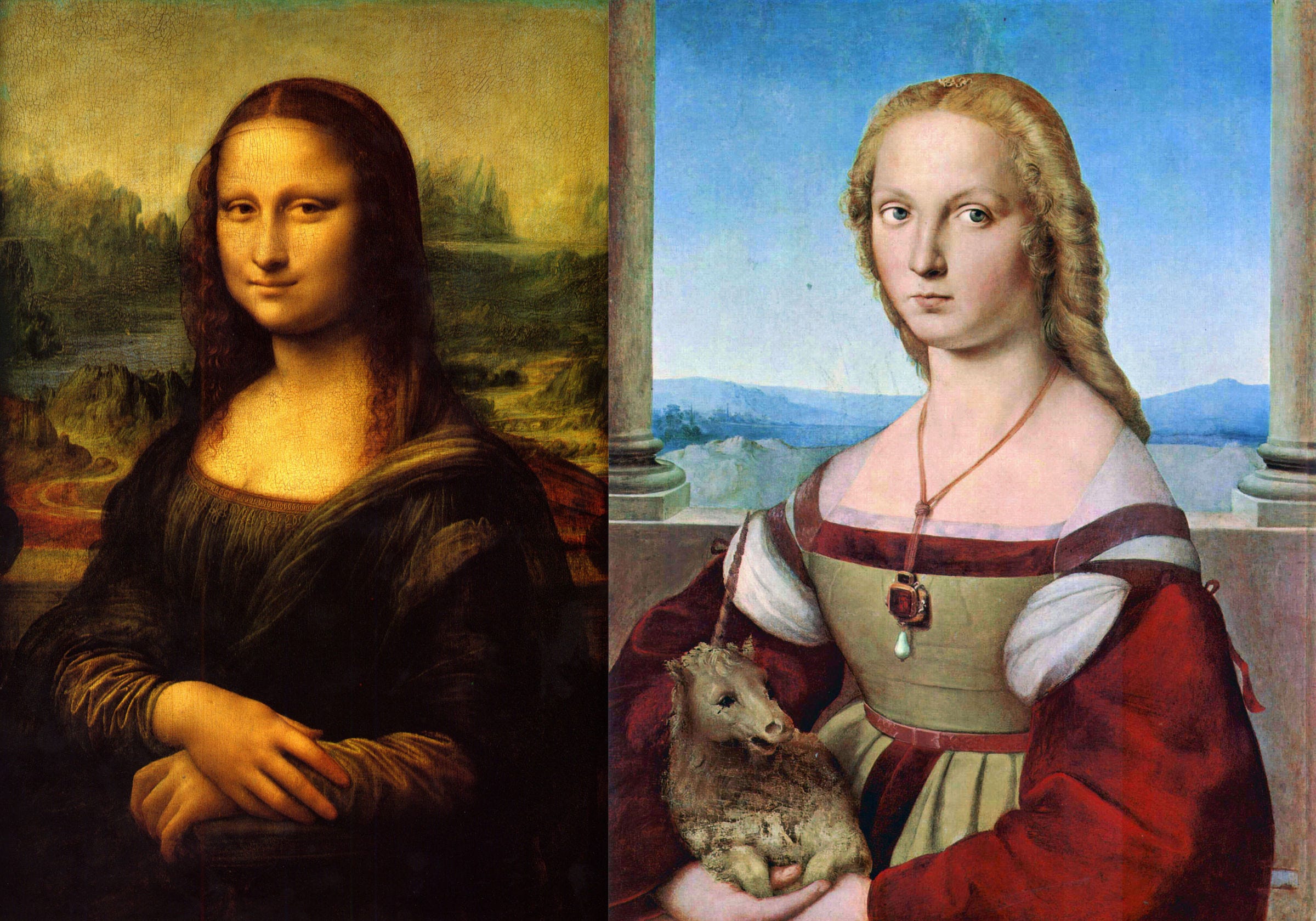
Raphael saw the Mona Lisa during what art historians call his “Florence Period.” That’s when he was spending a lot of time in Florence, studying the work of various painters. They might as well call it his Leonardo Period, because that’s when his work started to look more and more like Leonardo’s.
What makes the Mona Lisa such a special painting is the way Leonardo represented light and shadow. Everything in it is a carefully-modeled shape. There are no outlines – only surfaces that curve away from the viewer.
Leonardo devised a system of so-called “pyramids of light,” in which light bounced off every point of every object, eventually converging in the eye of the viewer. Historian Martin Kemp has compared it to modern-day ray-tracing software – the kind Pixar uses to generate its animations.
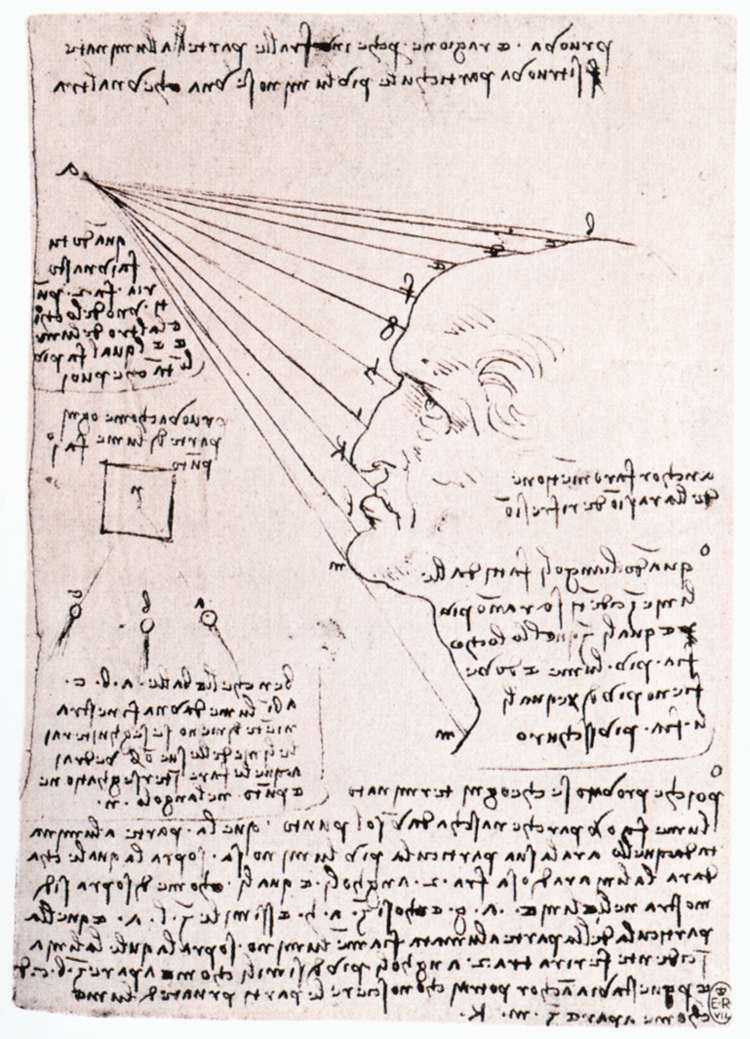
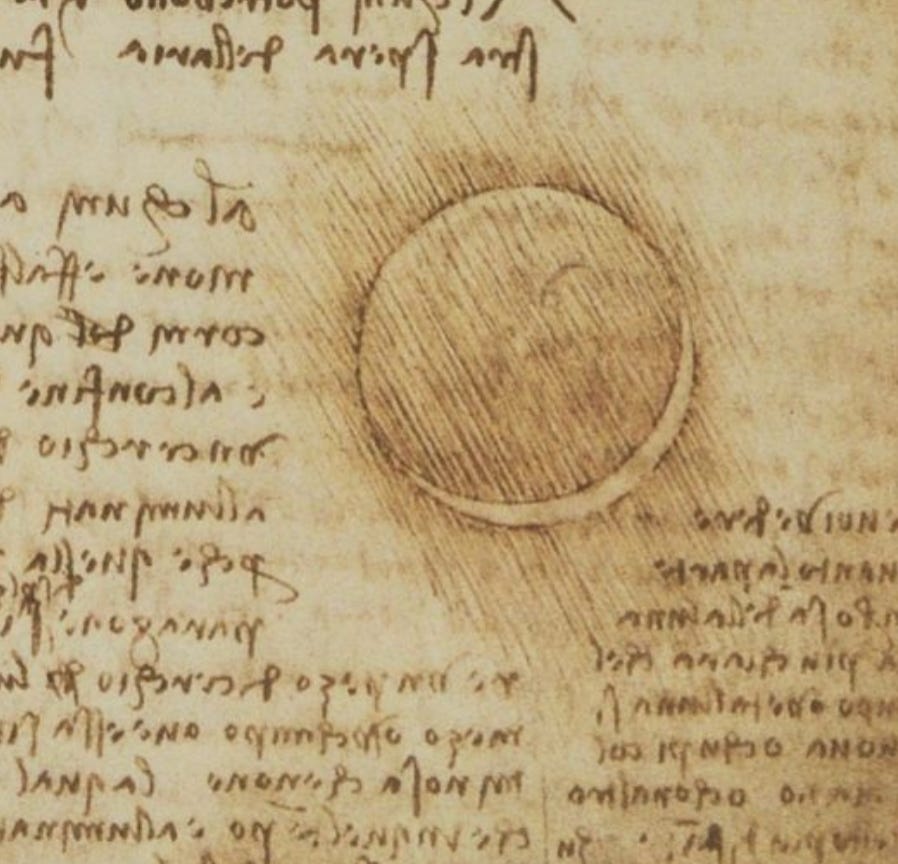
To develop such a detailed system, Leonardo needed to deeply understand light and shadow. That deep understanding goes hand-in-hand with why he was able to make prescient observations about the light and shadow of the moon.
At the time, many were mystified by why the shaded part of the moon wasn’t completely dark. Leonardo correctly theorized that the moon was not its own light source, as many thought, but that the shadow was illuminated by sunlight reflecting off the earth – what’s now known as “earthshine.”
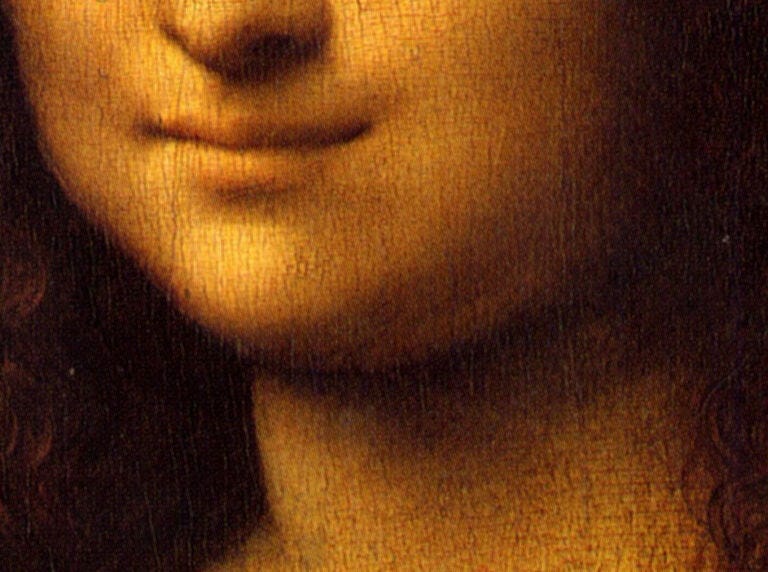
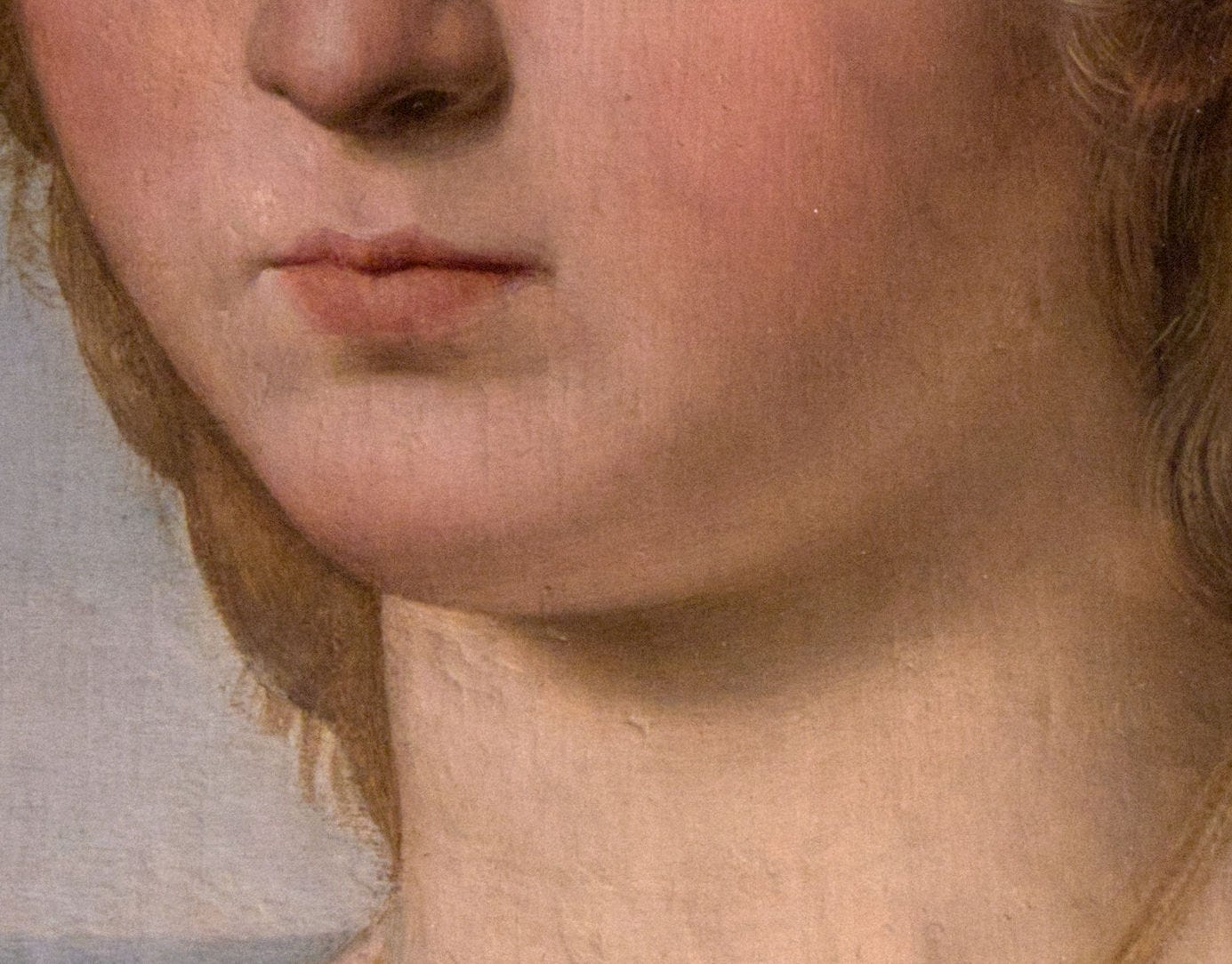
Leonardo put all this knowledge into his paintings, and we can see that in the Mona Lisa. Notice, for example, that the shadow under her chin is not completely dark. That’s where light is bouncing off her neck, chest, and shoulders.
From just a few years before Raphael saw the in-progress Mona Lisa, we can see a very simple chin-shadow in his first recorded commission.
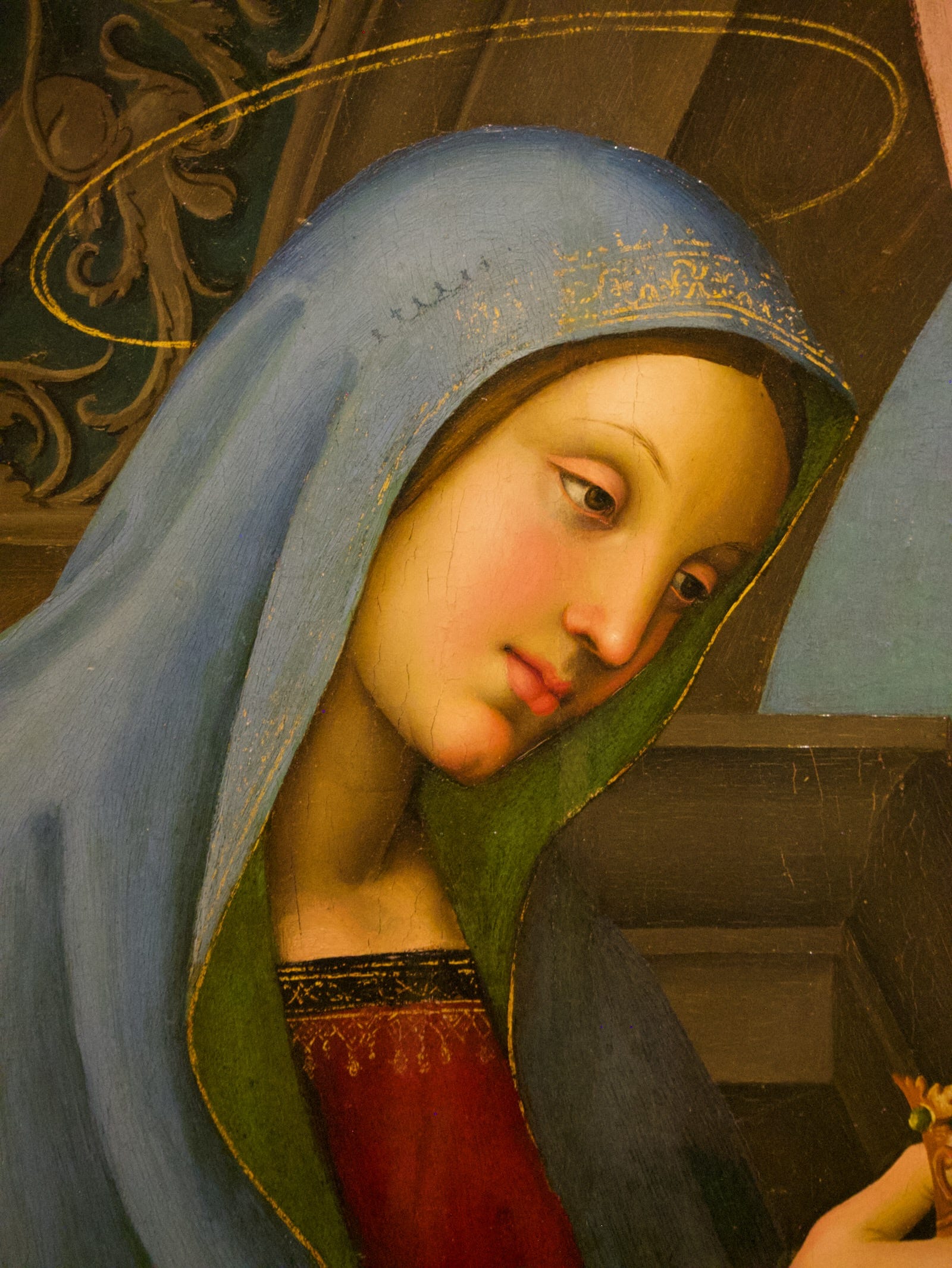
But in his Girl with Unicorn, we can see him imitating Leonardo’s use of light. (In fact, he kind of overdid it.)
Leonardo da Vinci’s innovative approach to painting was put together through thousands if not millions of observations, driven by his curiosity of the world. As historian Francesca Fiorani wrote:
”When [Leonardo] eventually delved into geology, botany, zoology, optics, and the study of water, he did so because all these fields also pertained to painting. At times, these other subjects took over his life entirely. Others were lifelong interests to which he returned intermittently. All, though, were subordinate to painting.“
—Francesca Fiorani2
Leonardo’s painting was just the tip of a gigantic iceberg of knowledge about the world. Raphael didn’t have to build that iceberg – he merely had to work from Leonardo’s conclusions.
It’s not that Raphael wasn’t innovative, talented, or deserving of the respect his work got. But while Leonardo cared about painting every bit as much as Raphael, his output was different, and his path to success was different, because he was curious. He didn’t accept what others had already figured out. He instead developed his own approach from many direct observations.
Every artist will build upon what they learn from those who come before, but with artists like Raphael (or Picasso), building upon existing innovations dominates their process. As Galenson told me, “It’s what conceptual innovators do, it turns out.”
So if you can’t figure out why others are more prolific and achieve success faster, look closely at their processes. Is your friend writing in a well-defined “niche” while you’re opining about the nature of existence? Are they mimicking their heroes while you’re piecing together your own approach? Then of course they’ll achieve success faster. But when you finally peak, your work will probably be more original.
It may not be that you’re any less talented, smart, or motivated. It may be that because you’re so curious, it takes longer to build your foundation.
Maybe your creative career is like one of those construction sites: There’s a wall around it with the project logo, and people walk by for months, wondering, What are they even doing? Then the next time they pass, there’s a twelve-story building.
***
In Finish What Matters, I’ll show you how to embrace your inner Leonardo while channeling your inner Raphael. Pre-order on Amazon »
Art history buffs might notice that Raphael died at only thirty-seven. But by that time the quality of his work had declined. Galenson has found that conceptual innovators tend to be comfortable letting others execute their ideas, and Raphael was no exception. Notice also that even if you counted The Last Supper as Leonardo’s most significant work, he was older than Raphael ever lived (his forties).
From The Shadow Drawing: How Science Taught Leonardo How to Paint